size it up archive
Size It Up Past Puzzles: A History of the Official Archive
Explore size it up past puzzles, the official archive, puzzle history, replay features, and how players can study previous Size It Up games.

Size It Up Past Puzzles: A History of the Official Archive
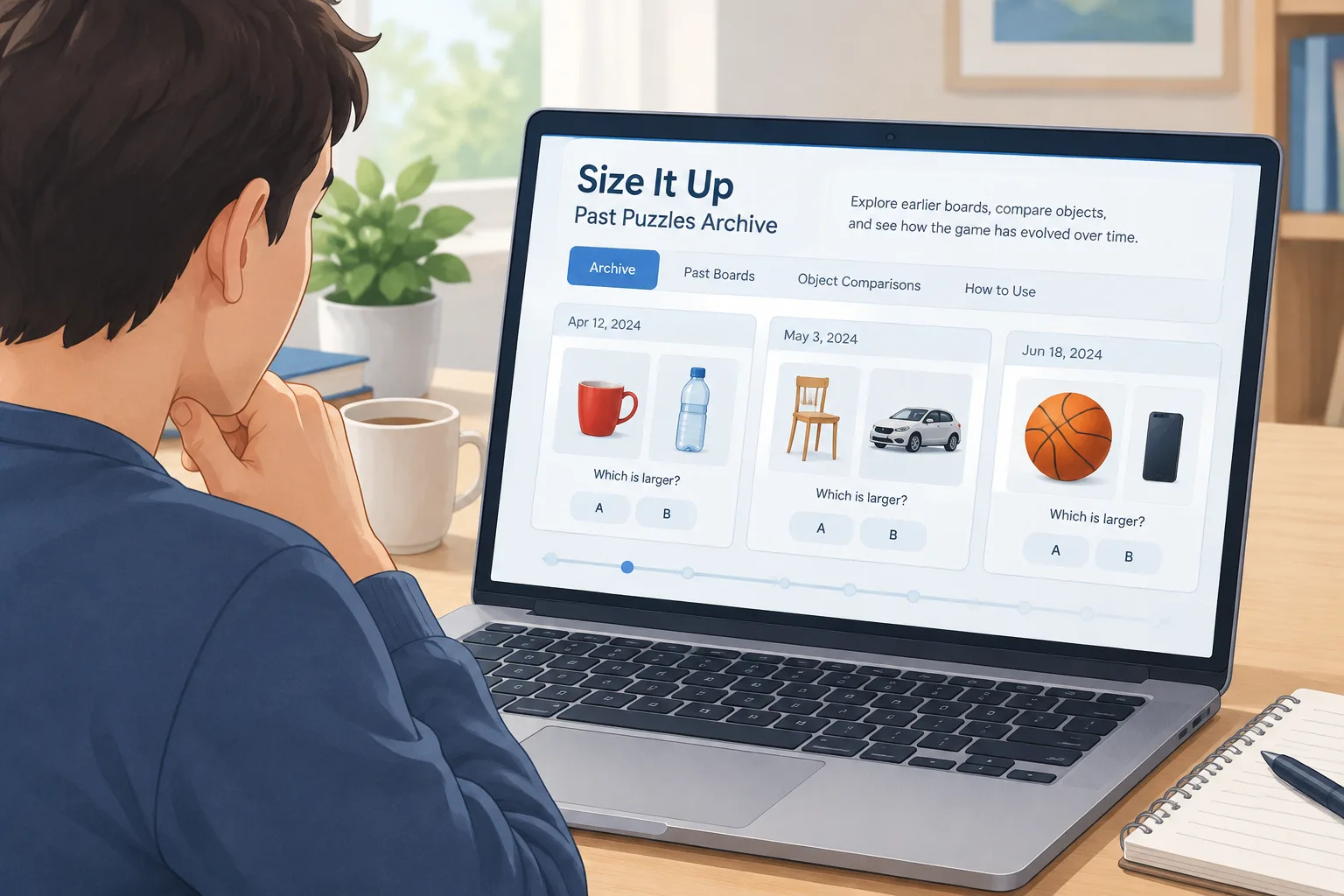
The size it up past puzzles archive gives players a way to look back at earlier Size It Up boards and understand how the game has developed over time. Instead of focusing only on a single daily challenge, the archive allows players to revisit previous comparisons, study object choices, and improve their ability to estimate real-world sizes.
This wiki guide explains what the official archive shows, how players can use past boards as learning material, and what can be confirmed about Size It Up puzzle history. This page focuses on verified archive features and practical analysis methods rather than unconfirmed patterns or invented statistics.
What are size it up past puzzles?
Size it up past puzzles are previous daily boards from the Size It Up game that players can revisit through the official archive. Each archived puzzle provides a record of an earlier challenge and lets players examine the objects that appeared in that comparison set.
The archive is useful because estimation skill improves when players become familiar with different scales. A person who has previously compared vehicles, animals, buildings, landmarks, or other objects may develop stronger reference points for future guesses.
Players looking for the basics of the game can also review the Size It Up basics guide, which explains the general structure and purpose of the game.
How does the official Size It Up archive work?
The official Size It Up archive provides access to past boards from the game. Players can browse previous challenges instead of only playing the current daily puzzle. This makes the archive a useful reference library for anyone interested in reviewing older comparisons.
The archive can help players in several ways:
- Reviewing previous object comparisons
- Practicing estimation without a daily time limit
- Understanding the range of subjects used in puzzles
- Building familiarity with different measurement scales
- Comparing personal guesses with known solutions
The archive should be treated as a learning resource rather than a promise that specific objects will return. A previous appearance does not prove that an object will appear again.
Players who want a complete introduction to the daily experience can visit the how to play Size It Up guide.
What can players learn from Size It Up puzzle history?
Size It Up puzzle history shows how a simple estimation format can cover many types of real-world objects. Looking through past puzzles can reveal the variety of subjects used by the game, from everyday items to larger-scale references.
A useful way to study past puzzles is to organize them by scale. For example:
| Scale category | Example comparison approach |
|---|---|
| Small objects | Think about household items and familiar dimensions |
| Human-scale objects | Use body measurements and everyday experiences |
| Large objects | Compare buildings, vehicles, or natural features |
| Very large objects | Use known landmarks or geographic references |
These categories are not official classifications of the game. They are a practical method players can use when studying archived boards.
The strongest learning comes from understanding relationships between objects. Instead of memorizing isolated answers, players can ask questions such as: Is this object closer in size to a person, a car, a room, or a landmark? That approach creates reusable estimation skills.
Can past size it up games help improve guesses?
Yes, past size it up games can help players practice, but they do not guarantee future answers. Previous boards provide examples of how the game presents comparisons, while each new puzzle still requires independent estimation.
A practical review process looks like this:
- Select an archived puzzle.
- Make a guess before checking the solution.
- Compare the guess with the actual size reference.
- Record objects that were difficult to estimate.
- Build personal reference points for similar objects.
For example, a player who struggles with estimating the height of structures may review several past landmark comparisons. Over time, they may develop a better sense of scale by connecting unfamiliar objects with familiar examples.
Players should separate confirmed information from personal strategy. The archive confirms previous boards, but theories about future puzzle patterns require additional evidence.
What does the archive reveal about object choices?
The archive provides the raw material for studying the kinds of objects included in Size It Up. Players can examine themes, compare categories, and identify areas where their own estimation knowledge is limited.
However, archive analysis should avoid unsupported claims. A player may notice that certain types of objects appear interesting or memorable, but a complete frequency analysis requires a defined dataset and a dated review of the archive.
Useful archive analysis questions include:
- Which object types are hardest for me to estimate?
- Which reference objects help me most often?
- Do I perform better with familiar everyday items or unusual objects?
- Which measurement ranges do I need more practice with?
For players who want deeper analysis methods, the archive analysis section provides a place to explore how archived games can be reviewed systematically.
How should beginners study the Size It Up archive?
Beginners should avoid trying to memorize every previous answer. The archive contains many examples, but estimation depends on understanding scale rather than recalling isolated facts.
A beginner-friendly approach includes:
Start with familiar references
Use objects you already understand. A person, a doorway, a car, or a room can become a mental measuring tool for other comparisons.
Learn common measurement relationships
Basic knowledge of measurement systems helps players judge whether an object is likely measured in centimeters, meters, kilometers, feet, or miles. Reliable measurement references make guesses more consistent.
Review mistakes carefully
A wrong guess is valuable when it reveals a misunderstanding. If an object was much larger or smaller than expected, note why the estimate failed.
Practice across different categories
Do not focus on only one type of object. A broad archive review builds flexibility because daily puzzles may involve different areas of real-world knowledge.

How is Size It Up puzzle history different from answers lists?
A puzzle history archive is broader than a simple answer list. An answer list records solutions, while a history view helps explain the context around those solutions.
A useful archive entry can include:
- The puzzle date
- The objects shown
- The comparison topic
- The correct size information
- Notes about estimation difficulty
This type of information helps players understand why a puzzle works, not just what the final answer was.
The Size It Up Wiki also covers related sections such as daily answers resources and game variations through the variants guide.
Frequently Asked Questions about size it up past puzzles
Where can I find size it up past puzzles?
Size it up past puzzles can be found through the official Size It Up archive provided by Magnitudle. The archive allows players to browse previous boards and review earlier challenges.
Are all previous Size It Up games available in the archive?
The official archive provides access to past boards according to the available archive features. Players should check the archive directly for the current selection and available modes.
Can I use past size it up games to predict future answers?
Past games can help players practice estimation and understand the game format, but previous puzzles do not confirm future answers. Any prediction method should be treated as a personal strategy rather than a verified feature.
Does Size It Up puzzle history include official statistics?
The archive provides past boards, but statistics such as object frequency or category trends should only be published after a specific analysis has been completed and dated. Visual impressions alone are not enough to prove a pattern.
What is the best way to improve at Size It Up?
The best approach is regular practice, careful review of mistakes, and building reliable mental references for different size ranges. Studying past puzzles can support this process by providing more examples.
Final thoughts on the Size It Up archive
The size it up past puzzles archive is valuable because it turns individual daily challenges into a larger learning resource. Players can revisit earlier boards, understand object relationships, and develop better estimation habits through practice.
A strong archive review focuses on verified information: what puzzles are available, what objects were included, and what lessons can be learned from each comparison. By using the archive as a study tool rather than a prediction shortcut, players can better understand both the game mechanics and the real-world scales behind each challenge.
For the latest official experience, players should use the official Size It Up game and treat community wiki resources as independent guides for learning and analysis.