size it up theme patterns
Size It Up Theme Patterns: Object Families and Difficulty Rhythm
Explore size it up theme patterns, object families, and size it up difficulty changes with a practical wiki guide to recognizing categories, estimating scale, and understanding daily boards.
Size It Up Theme Patterns: Object Families and Difficulty Rhythm
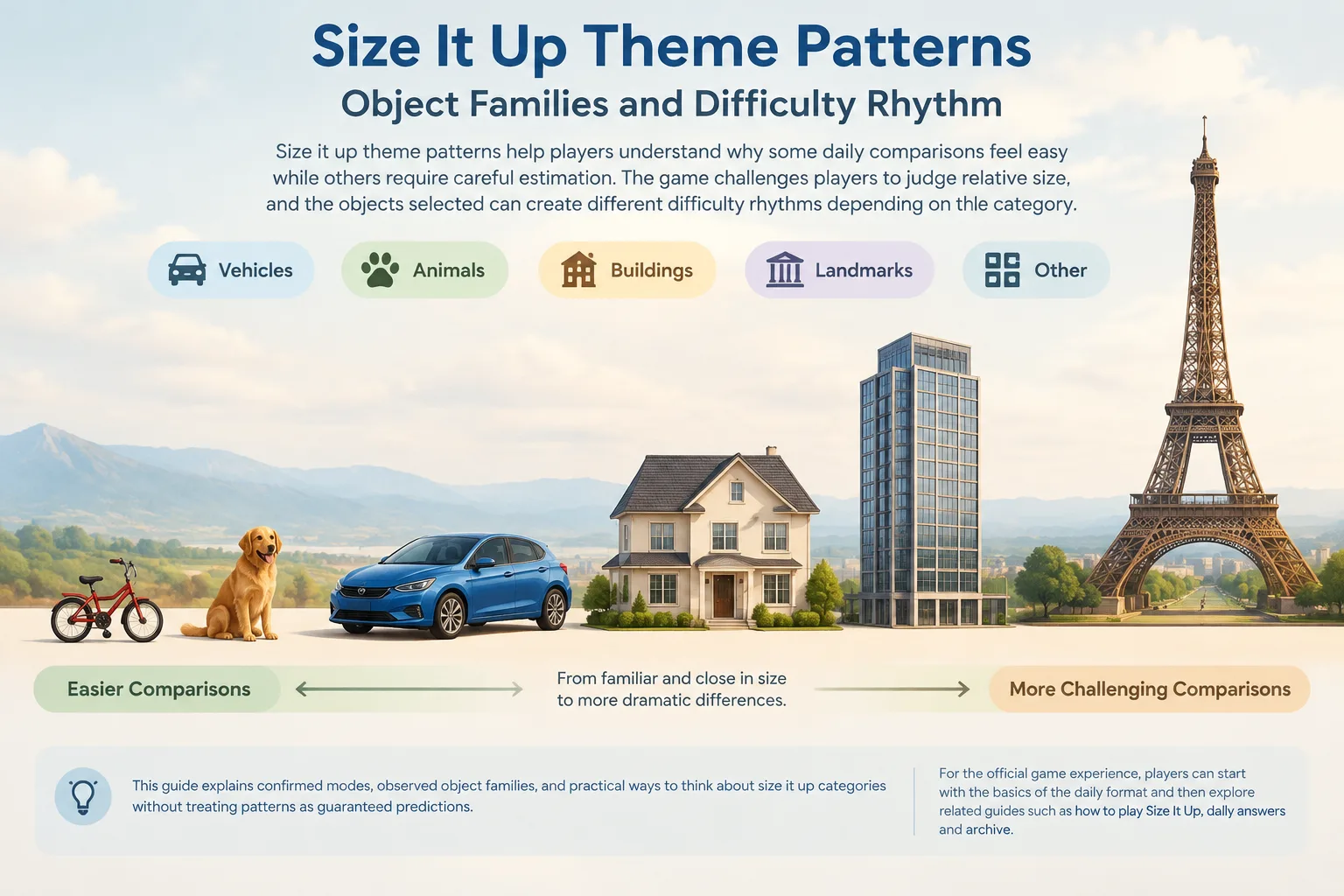
Size it up theme patterns help players understand why some daily comparisons feel easy while others require careful estimation. The game challenges players to judge relative size, and the objects selected can create different difficulty rhythms depending on whether the comparison involves animals, places, vehicles, structures, or other categories. This guide explains confirmed modes, observed object families, and practical ways to think about size it up categories without treating patterns as guaranteed predictions.
For the official game experience, players can start with the basics of the daily format and then explore related guides such as how to play Size It Up, daily answers and archive information, and variant explanations. This wiki focuses on understanding the design patterns behind the game rather than predicting future boards.
What are size it up theme patterns?
Size it up theme patterns describe recurring ways objects can be grouped by type, scale, or context. These patterns are useful because the game is built around comparing real-world measurements, so recognizing an object's category can provide a starting point before making a final estimate.
The official Size It Up experience includes a base game focused on real-world things, along with variant modes that introduce different types of comparisons. The Geography variant includes places such as countries, states, lakes, cities, and natural wonders, while the Pop Culture variant focuses on famous characters. These confirmed modes create broad families of content that shape how players approach comparisons.
Confirmed families from official modes
The clearest size it up object families come from the official mode structure:
- Real-world things in the main Size It Up game
- Famous characters in the Pop Culture variant
- Geographic locations and natural features in the Geography variant
These categories create different estimation challenges. A character comparison may depend on fictional context, while a geography comparison often involves very large measurements such as area, distance, or natural features.
How do size it up object families affect gameplay?
Size it up object families affect gameplay by changing the reference points players naturally use. A player comparing two buildings may think in terms of floors, height, and landmarks. A player comparing animals may need to switch between body length, mass, wingspan, or other dimensions depending on the object.
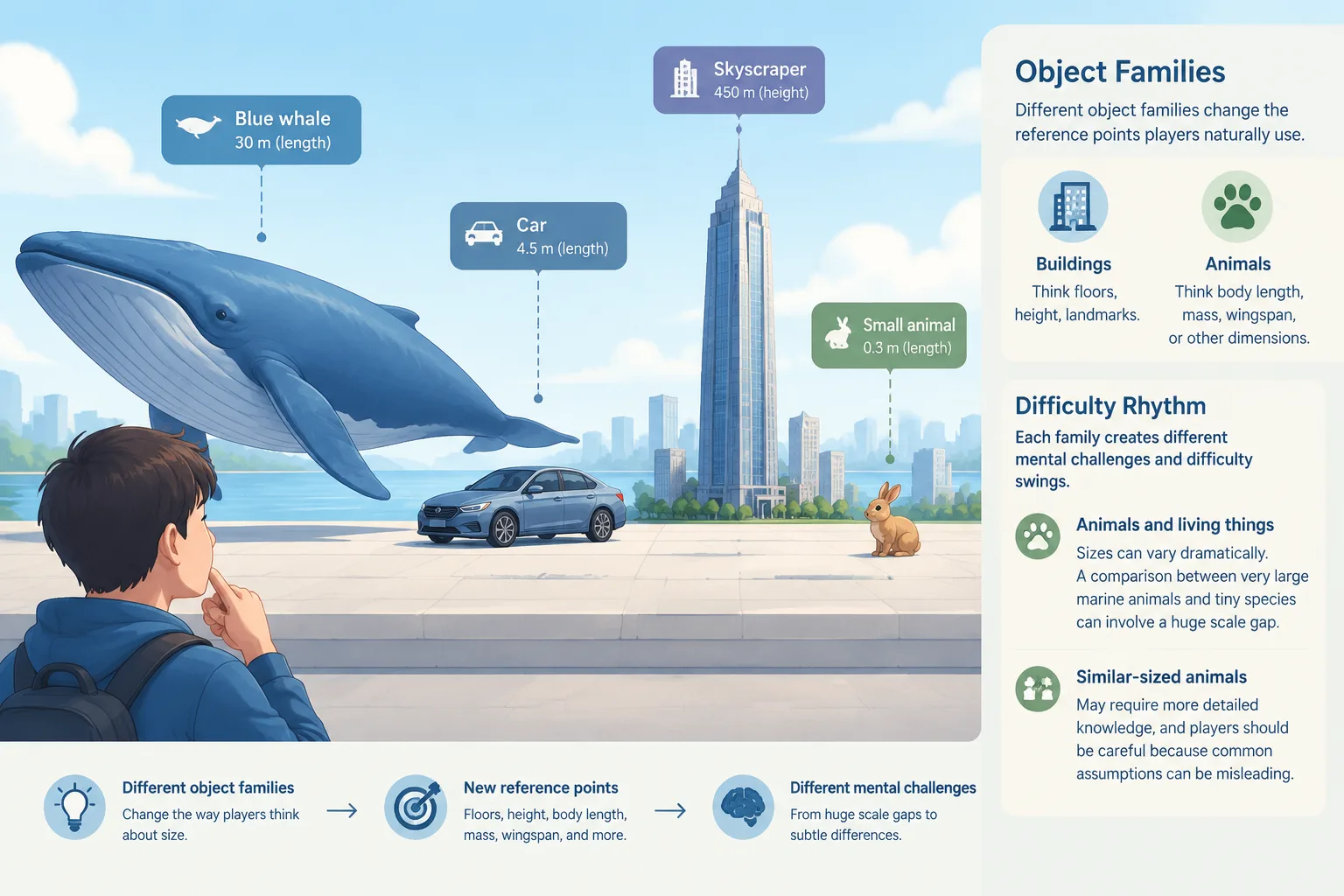
Different families create different mental challenges:
Animals and living things
Animals can create large difficulty swings because their sizes vary dramatically. A comparison between very large marine animals and tiny species can involve a huge scale gap. Meanwhile, comparisons between similarly sized animals may require more detailed knowledge.
Players should be careful because common impressions can be misleading. An animal that appears large in a photograph may not have the largest measurable dimension, and visual perspective often changes how size is perceived.
Vehicles
Vehicles are often easier to estimate because many players have familiar references. Cars, buses, ships, and aircraft can be compared using everyday experiences, but unusual vehicles can still create difficult rounds.
For vehicles, useful reference questions include:
- Is this object commonly seen in daily life?
- Is the measurement based on length, height, weight, or another factor?
- Does the category include both ordinary and specialized examples?
Landmarks and structures
Buildings and landmarks often produce a different kind of challenge. Many structures are measured by height, while others are known for length, area, or volume. Two famous structures may both feel enormous, but the actual difference can be difficult to judge.
The game becomes especially interesting when objects come from different families, such as comparing a natural object with a human-made structure. The player must decide which measurement matters before making a guess.
Why does size it up difficulty change between categories?
Size it up difficulty changes because different object families have different measurement ranges and different levels of familiarity. Categories with extreme size variation can create larger jumps, while categories with similar objects may demand more precise knowledge.
A useful way to understand difficulty is through scale distance. If two possible answers are separated by a massive difference in size, the comparison may feel easier. If they occupy a similar range, the player needs stronger reference knowledge.
Large-scale categories
Geography and certain natural features often involve very large measurements. Countries, lakes, and natural wonders can differ by enormous amounts, but players may struggle because these objects are rarely viewed directly at their true scale.
Compressed-scale categories
Buildings, vehicles, and related human-made objects may feel harder when many examples exist within a similar range. A player may know that two skyscrapers are tall but have difficulty estimating the exact relationship.
How can players use theme patterns without overpredicting answers?
Theme patterns should be used as a learning tool, not as a guaranteed shortcut. The presence of a category in previous games does not mean the next board will follow the same sequence.
A practical approach is:
- Identify the object family.
- Decide the likely measurement being compared.
- Choose a familiar reference object.
- Estimate the range before selecting a final answer.
- Adjust only when new information changes the comparison.
For example, if a player sees a large ship, they can compare it mentally with familiar vessels, buildings, or transportation examples. If the object is an animal, they may instead use known species ranges as anchors.
More structured practice methods are available in the archive analysis section, where players can examine how categories and comparisons appear over time.
Are there official patterns for future Size It Up boards?
There are no official guarantees that future boards follow a repeating category schedule. Players can analyze previous games for learning purposes, but observed patterns should remain separate from confirmed mechanics.
The official game pages define the available modes and formats, but they do not establish a public prediction system for upcoming objects. A category appearing frequently in a player's personal review does not mean it will appear next.
This distinction matters because estimation games reward flexible reasoning. The strongest strategy is not guessing a hidden pattern but improving the ability to compare unfamiliar objects.
How do variants change size it up categories?
Variants expand size it up categories by changing the type of information players need. The Geography mode moves the focus toward places and natural features, while Pop Culture introduces famous characters as comparison targets.
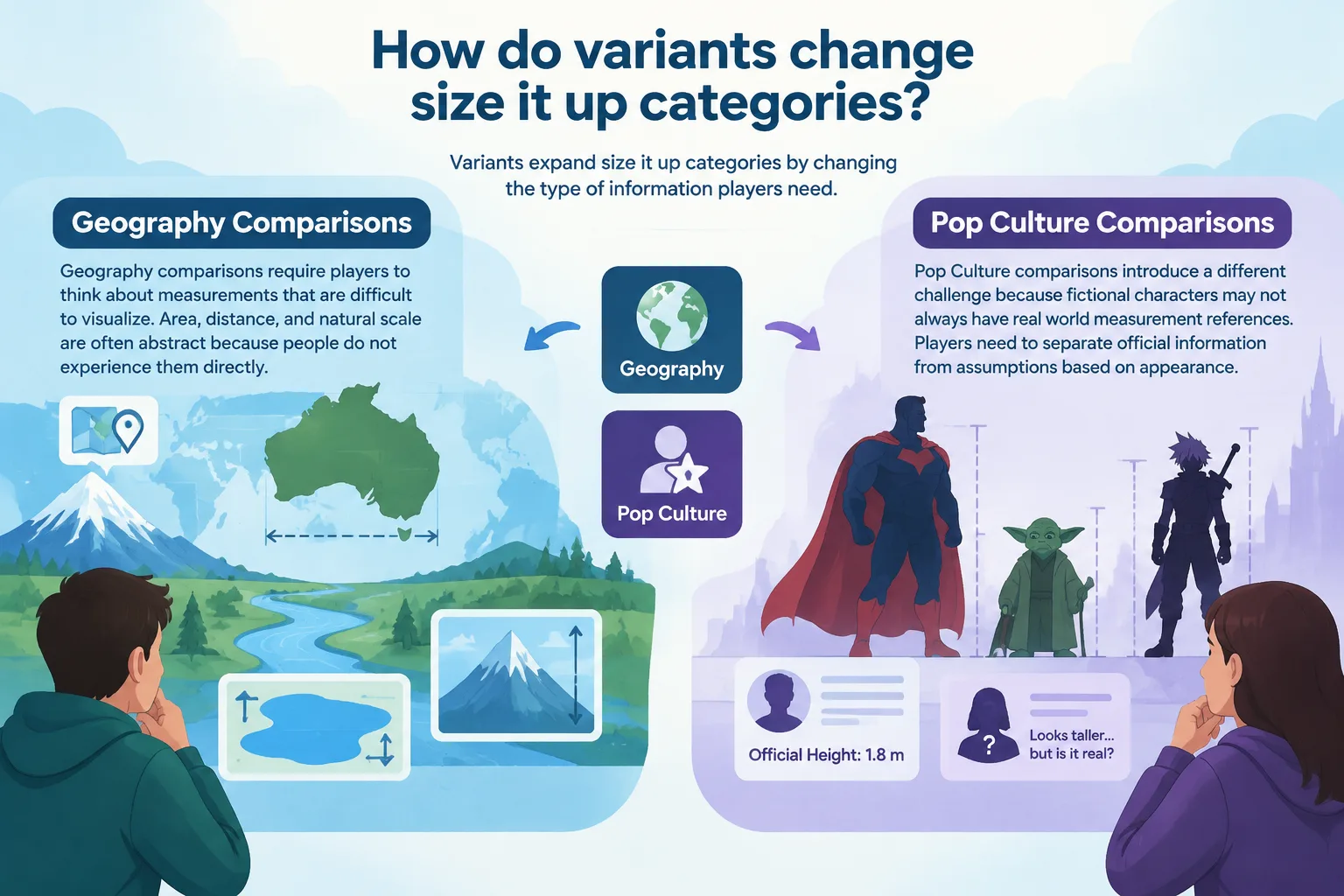
Geography comparisons
Geography comparisons require players to think about measurements that are difficult to visualize. Area, distance, and natural scale are often abstract because people do not experience them directly.
Pop Culture comparisons
Pop Culture comparisons introduce a different challenge because fictional characters may not always have real-world measurement references. Players should separate official information from assumptions based on appearance.
Frequently asked questions about size it up theme patterns
What are size it up theme patterns?
Size it up theme patterns are recurring ways of organizing game objects by category, mode, or scale. They help players understand why different rounds can feel easy or difficult, but they do not provide guaranteed predictions.
What are the main size it up categories?
The main confirmed categories come from official modes: real-world things in the base game, famous characters in Pop Culture, and geographic subjects in Geography. Other families may be useful as observations when reviewing past boards.
How do size it up object families help players?
Size it up object families help players select better reference points. Knowing whether an object is an animal, vehicle, structure, or place can guide the type of comparison that makes the most sense.
Why does size it up difficulty feel different every day?
Size it up difficulty changes because each comparison has different scale ranges, familiarity levels, and measurement challenges. Some objects have obvious reference points, while others require more careful estimation.
Can players predict future Size It Up answers from patterns?
Players can study patterns for practice, but there is no confirmed public rule that future answers follow a fixed sequence. Pattern analysis is best used to improve estimation skills rather than make certain predictions.
Final thoughts on size it up theme patterns
Understanding size it up theme patterns gives players a better framework for approaching comparisons. Object families provide useful mental categories, while difficulty rhythm explains why some rounds feel straightforward and others require deeper reasoning.
The most reliable improvement comes from building a broad sense of scale: knowing familiar objects, comparing measurements carefully, and treating every round as a new estimation challenge. Use the wiki resources for game basics, daily information, and variant guides to continue developing your Size It Up knowledge.