size it up hints
Size It Up Hint Without Spoilers: A Graduated Hint System
Learn how to use a size it up hint system without spoilers. This guide explains graduated clues, estimation techniques, game mechanics, and ways to improve your Size It Up guesses.
Size It Up Hint Without Spoilers: A Graduated Hint System
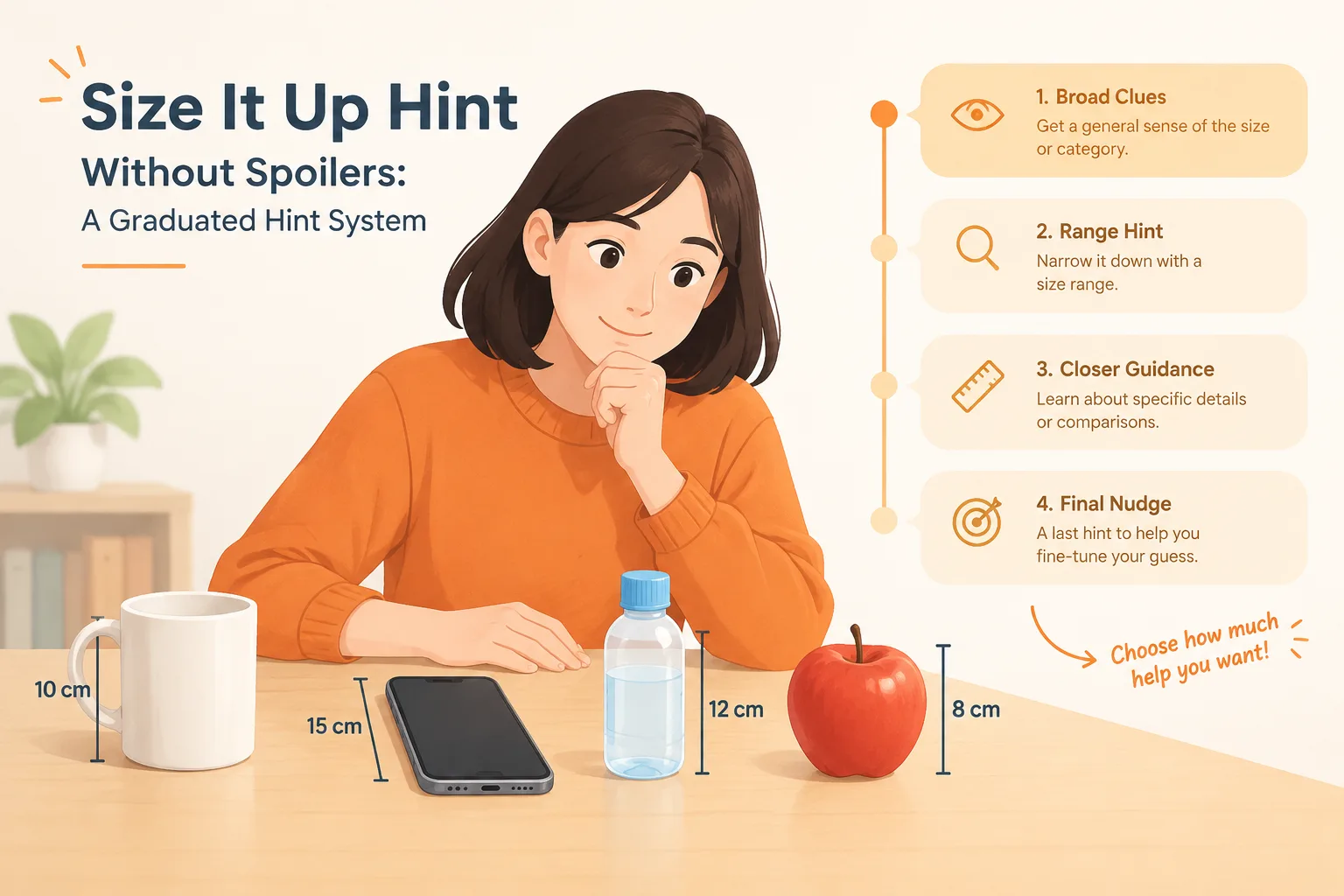
A size it up hint can help you solve a difficult daily challenge without removing the satisfaction of making the final guess yourself. Size It Up is a size-estimation game where players compare an unknown object with a reference and adjust their guess before locking it in. The answer is hidden until the guess is submitted, so a careful hint system can provide guidance while keeping the discovery experience intact.
This guide explains a spoiler-free hint ladder used by this fan-made wiki. The ladder is an editorial format created for helping players, not an official feature of the game. It moves from broad clues to more specific guidance so players can decide how much help they want before seeing an answer.
What is a size it up hint system and how does it work?
A size it up hint system is a structured way to receive clues gradually instead of immediately viewing the solution. The goal is to improve your estimation process while preserving the challenge of the daily puzzle.
The four-level hint ladder used on this wiki is:
- Category hint — identifies the general type of object.
- Context hint — adds information such as environment, era, or common use.
- Scale hint — explains whether the object is much larger, smaller, or similar to the reference.
- Reveal hint — provides the final answer when a player chooses to check it.
The first three levels are designed to support reasoning rather than replace it. Many players improve by learning how to think about relative size, not simply memorizing answers.
For more information about the basic game structure, visit the Size It Up basics guide. For mechanics and guessing steps, the how to play guide explains the resize-and-lock-in process in more detail.
Why does a gradual hint ladder help players estimate size?
A gradual hint ladder works because human estimation improves when the brain has a useful reference point. A category clue immediately reduces the number of possible answers. A scale clue then helps players create a mental comparison.
For example, imagine a puzzle involving an unknown animal. A category hint tells you it is an animal rather than a vehicle or building. A context hint might suggest that it lives in the ocean or on land. A scale hint tells you whether it is closer to a small pet, a person, or a large whale.
These steps help players build a proportional estimate instead of making a random guess.
Measurement is based on comparing quantities with agreed standards. Understanding units and relative scale is useful in many estimation games, because players often need to translate visual impressions into approximate measurements.
How can you use a size it up hint today without getting spoilers?
A size it up hint today should be used as a learning tool, not just a shortcut. Before opening a clue, try making an independent estimate. Then use the smallest hint level that addresses your uncertainty.
A practical approach is:
Start with your own estimate
Look at the reference object and decide what you already know. Ask questions such as:
- Is the unknown object something I see in daily life?
- Is it usually measured in centimeters, meters, or kilometers?
- Would a person stand beside it, hold it, or travel inside it?
These questions establish a rough range before any clue is revealed.
Use category clues first
A category clue is often enough to remove confusion. Knowing that something is a landmark, vehicle, animal, or pop culture item changes the possible scale dramatically.
Use scale clues when your estimate is too broad
A scale hint is especially useful when several possibilities remain. If you think an object could be anywhere from five meters to fifty meters long, knowing that it is larger than a bus but smaller than a skyscraper creates a much narrower range.
For daily puzzle records and previous challenges, the daily answers section provides a place to explore completed games after you have finished guessing.
What are the different types of size it up clues?
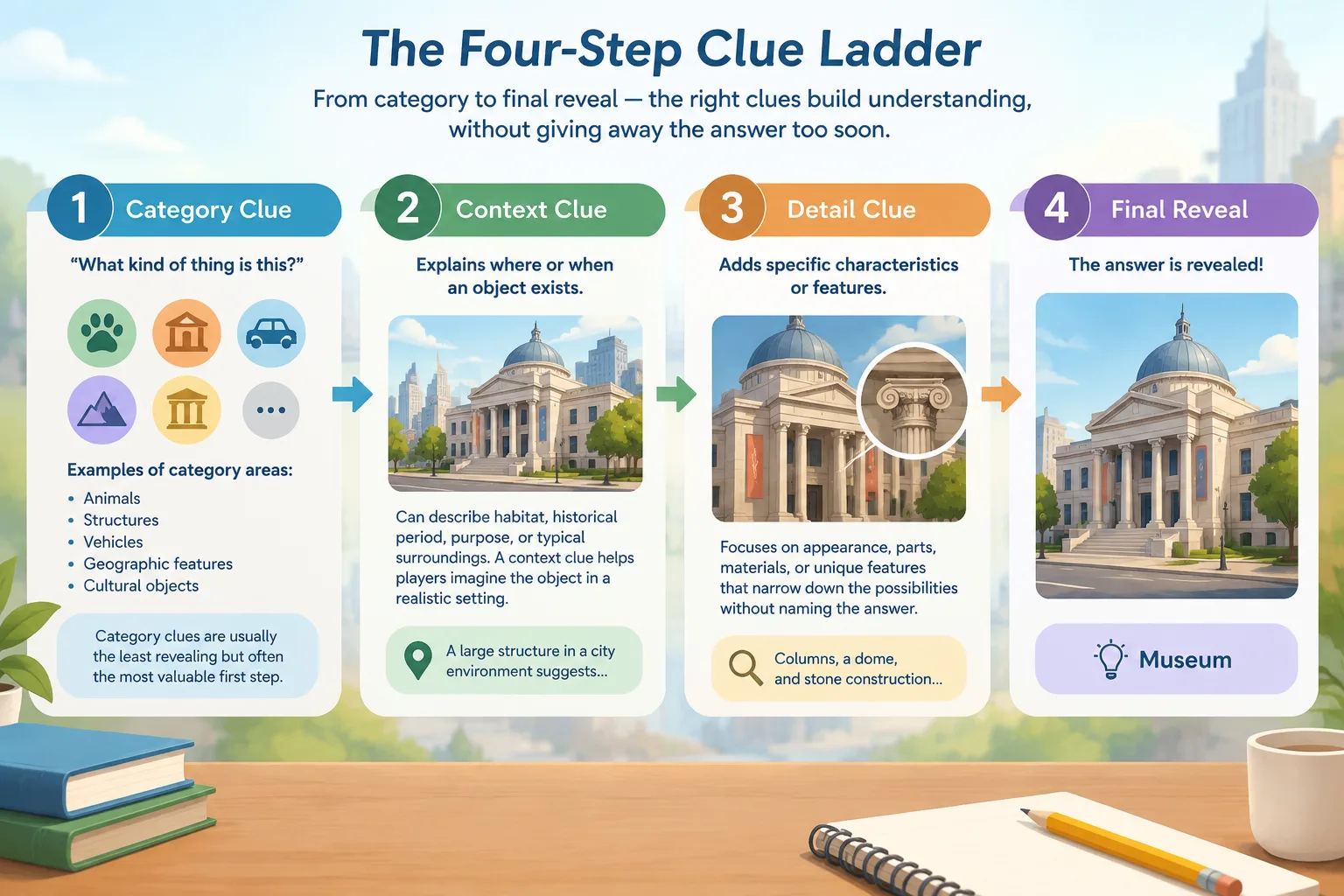
Size it up clues can focus on different parts of the reasoning process. Good clues avoid giving away the answer immediately while still helping players understand the object.
Category clues
Category clues answer the question: “What kind of thing is this?” They are usually the least revealing but often the most valuable first step.
Examples of category areas include:
- animals
- structures
- vehicles
- geographic features
- cultural objects
Context clues
Context clues explain where or when an object exists. They can describe habitat, historical period, purpose, or typical surroundings.
A context clue helps players imagine the object in a realistic setting. A large structure in a city environment suggests a different scale from a natural feature found across a continent.
Scale clues
Scale clues directly support measurement judgment. They may indicate comparisons such as:
- smaller than a human
- around the size of a car
- larger than a house
- comparable to a major landmark
These clues are powerful because they connect an unfamiliar object to something familiar.
Reveal clues
A reveal clue gives the answer. It is the final step and should normally be used only after attempting the puzzle.
How do you improve at Size It Up without relying on hints?
Hints are useful, but long-term improvement comes from building stronger estimation habits. Players can practice by comparing everyday objects and learning common reference sizes.
Useful techniques include:
Build a personal reference library
Remember approximate sizes of familiar objects:
- a person’s height
- a doorway
- a car length
- a football field
- a tall building
These references become mental measuring tools during gameplay.
Think in ranges instead of exact numbers
Many players make the mistake of searching for one perfect number too early. Estimation is usually more successful when you first create a range and then narrow it.
For example, instead of guessing “this must be exactly 18 meters,” think “this seems larger than a house but smaller than a stadium, so perhaps it is between 15 and 40 meters.”
Learn from completed puzzles
Reviewing previous answers can reveal patterns. The archive analysis section can help players examine past themes and improve their approach to future rounds.
Are size it up clues official game features?
The hint ladder described here is a fan-made editorial system from Size It Up Wiki. It should not be considered an official feature unless the game publisher specifically states otherwise.
The official Size It Up game is published by Magnitudle. Players should check the official game experience for the current rules and available features.
This distinction matters because community guides often create helpful strategies that are separate from the original game design.
Common mistakes when using size it up hints
Using hints effectively requires balance. Some common mistakes include:
Reading the strongest hint first
Jumping directly to a final clue removes the opportunity to practice estimation. Start with the weakest hint that answers your question.
Ignoring the reference object
The reference object is the foundation of the comparison. A clue is much more useful when connected to that reference.
Treating guesses as exact measurements
Size It Up is an estimation challenge. Real-world objects can vary, and many measurements depend on how an object is defined.
Frequently Asked Questions about size it up hint
What is a size it up hint?
A size it up hint is a clue that helps players estimate the hidden object's size without immediately revealing the answer. A gradual hint system provides information in stages so players can keep solving independently.
Is the size it up hint today available for every puzzle?
A size it up hint today depends on whether a guide or community entry has been created for that specific puzzle. Players can also use general estimation techniques when a puzzle-specific hint is unavailable.
Are size it up hints official?
The graduated hint ladder described on this wiki is a fan-made format. The official game determines its own features, rules, and available options.
Do size it up clues make the game too easy?
Size it up clues do not have to make the game easier if they are used gradually. Starting with broad clues allows players to continue practicing their own judgment.
Where can I find more Size It Up guides?
You can explore the wiki sections for gameplay basics, variants, daily puzzles, and historical analysis. The variants guide covers different puzzle themes and formats.
Final thoughts on using size it up hints without spoilers
A good size it up hint should encourage better thinking, not simply reveal an answer. The best approach is to begin with your own estimate, request the smallest useful clue, and use each hint as a lesson about scale and comparison.
Whether you are solving the daily board or reviewing past puzzles, a structured hint system can make difficult rounds more enjoyable while preserving the challenge that makes estimation games engaging.