size it up game tips
Size It Up Game Tips: Estimation Techniques to Judge Scale Faster
Learn size it up game tips, scale estimation techniques, and practical size it up strategy methods for improving your guesses in the Magnitudle Size It Up game.

Size It Up Game Tips: How to Judge Scale Faster
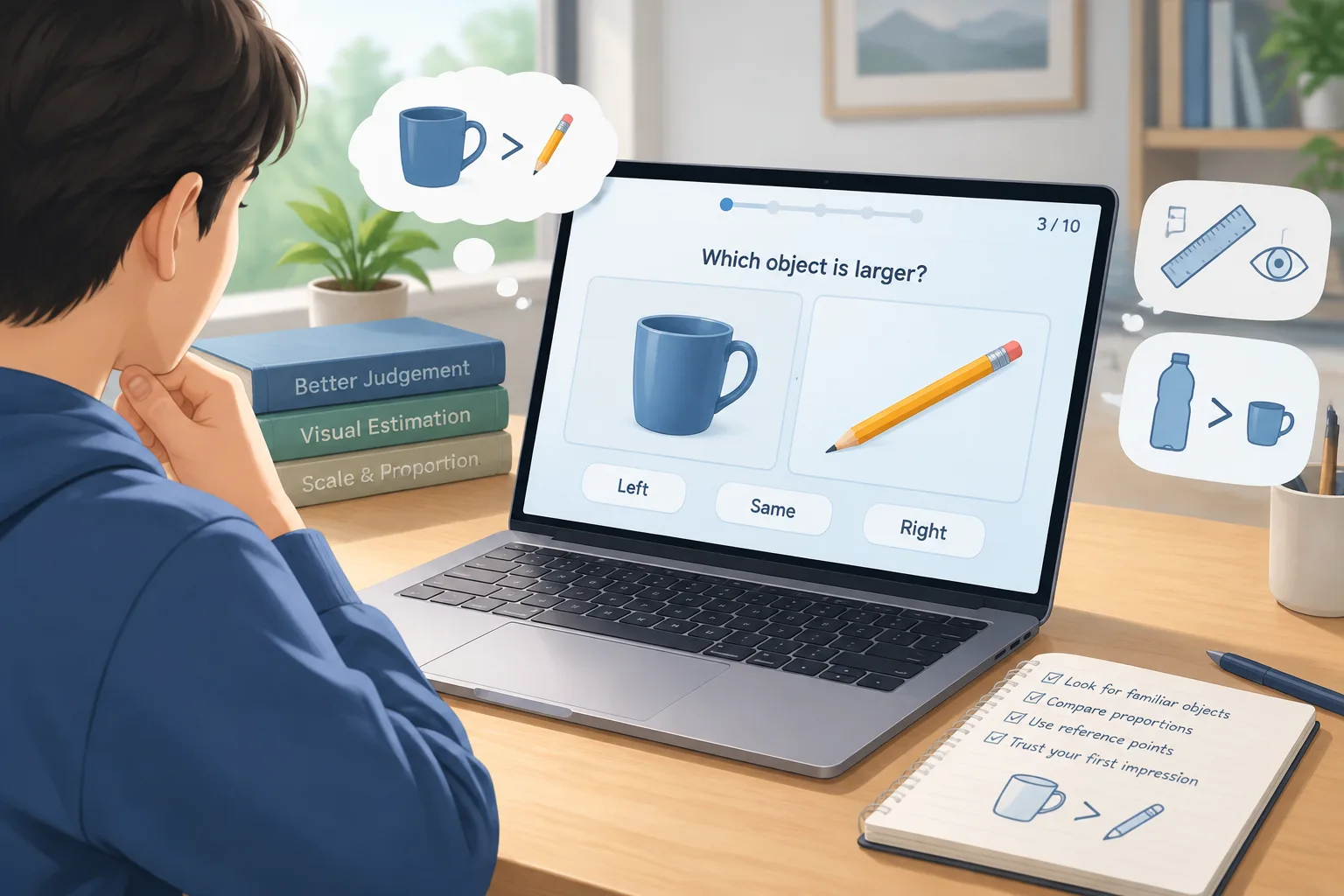
Getting better at size it up game tips starts with understanding what the challenge actually tests. Size It Up is a proportional judgment game where players compare the size of a target with a reference object and try to estimate the correct relationship between them. The goal is not simply remembering measurements; it is building a reliable sense of scale. This guide explains the basic idea behind the game, practical estimation habits, and community strategies that can help players make faster decisions.
The official Size It Up game by Magnitudle presents a comparison-based experience where players judge relative size and lock in their estimate to see how close they were. The following techniques are strategy suggestions from estimation practice, not official rules or guaranteed methods. For more background on the game format, see the Size It Up Wiki guides for how to play and game basics.
What is the main idea behind Size It Up?
Size It Up is a scale estimation game built around comparing one object with another. Instead of asking players to recall an exact measurement, the game focuses on recognizing ratios. A player might need to decide whether an object is slightly larger, several times larger, or dramatically larger than a reference item.
The most important mindset shift is to think in relationships rather than isolated numbers. Many people know that a building is tall or that an animal is large, but the challenge is deciding how large compared with another object. Estimation works better when you first identify the general scale category and then refine the guess.
Players can explore related topics through the daily answers archive, which helps organize past examples and object comparisons.
How does the size it up estimation technique work?
The size it up estimation technique works by creating a mental measurement process. Start by identifying a familiar reference point, decide the approximate order of magnitude, and only then adjust for smaller differences. This approach reduces random guessing because each decision follows a repeatable sequence.
A useful process is:
- Identify the object type and its usual size range.
- Compare it with a familiar item from daily life.
- Decide whether the difference is small, medium, or extreme.
- Adjust your estimate after checking proportions.
- Lock in the answer when additional thinking is unlikely to improve the estimate.
For example, if comparing a vehicle with a person, begin with a simple anchor: a person is roughly a few times smaller in height than many vehicles. Then consider whether the specific vehicle is a compact model, a large truck, or something outside the everyday range.
This method is useful because humans are generally better at relative comparisons than recalling precise measurements. Measurement systems exist to create consistent values, but games based on estimation reward a strong sense of proportion.
What size it up tips help with difficult comparisons?
The best size it up tips focus on reducing uncertainty before making a final choice. Difficult comparisons often happen when both objects are unfamiliar or when the size difference is not obvious.
Use familiar anchors first
A familiar object can act as a mental ruler. Common anchors include a person, a door, a car, a room, or a building floor. These references are useful because they create a starting point before you think about unusual objects.
For example, when estimating the size of a large animal, do not immediately search your memory for an exact length. Instead, compare it with a known animal, a human body length, or another object with a more intuitive scale.
Check multiple dimensions
Size is not always about height. Width, length, volume, and overall presence can change perception. A long object may appear smaller if viewed from one angle, while a compact object may have surprising volume.
A good size it up strategy considers the dimension that matters most for the comparison. If the target is a landmark, height may dominate. If it is a vehicle or tool, length and overall shape may matter more.
Avoid false precision
One common mistake is trying to guess an exact number too early. If you are unsure whether something is 20 meters or 25 meters, focusing on the difference may waste time. First decide whether the correct scale is closer to 10 meters, 100 meters, or another range.
What is a strong size it up strategy for faster answers?
A strong size it up strategy combines speed with a structured thought process. Faster answers usually come from making fewer unnecessary comparisons, not from rushing.
A practical three-step strategy is:
Step one: Find the scale category
Ask whether the target is human-sized, vehicle-sized, building-sized, landscape-sized, or larger. This first decision removes many incorrect possibilities.
Step two: Select a mental reference
Choose a reference object that you understand well. If the reference is familiar, the comparison becomes easier. Avoid using a rare object from memory because uncertain references create uncertain estimates.
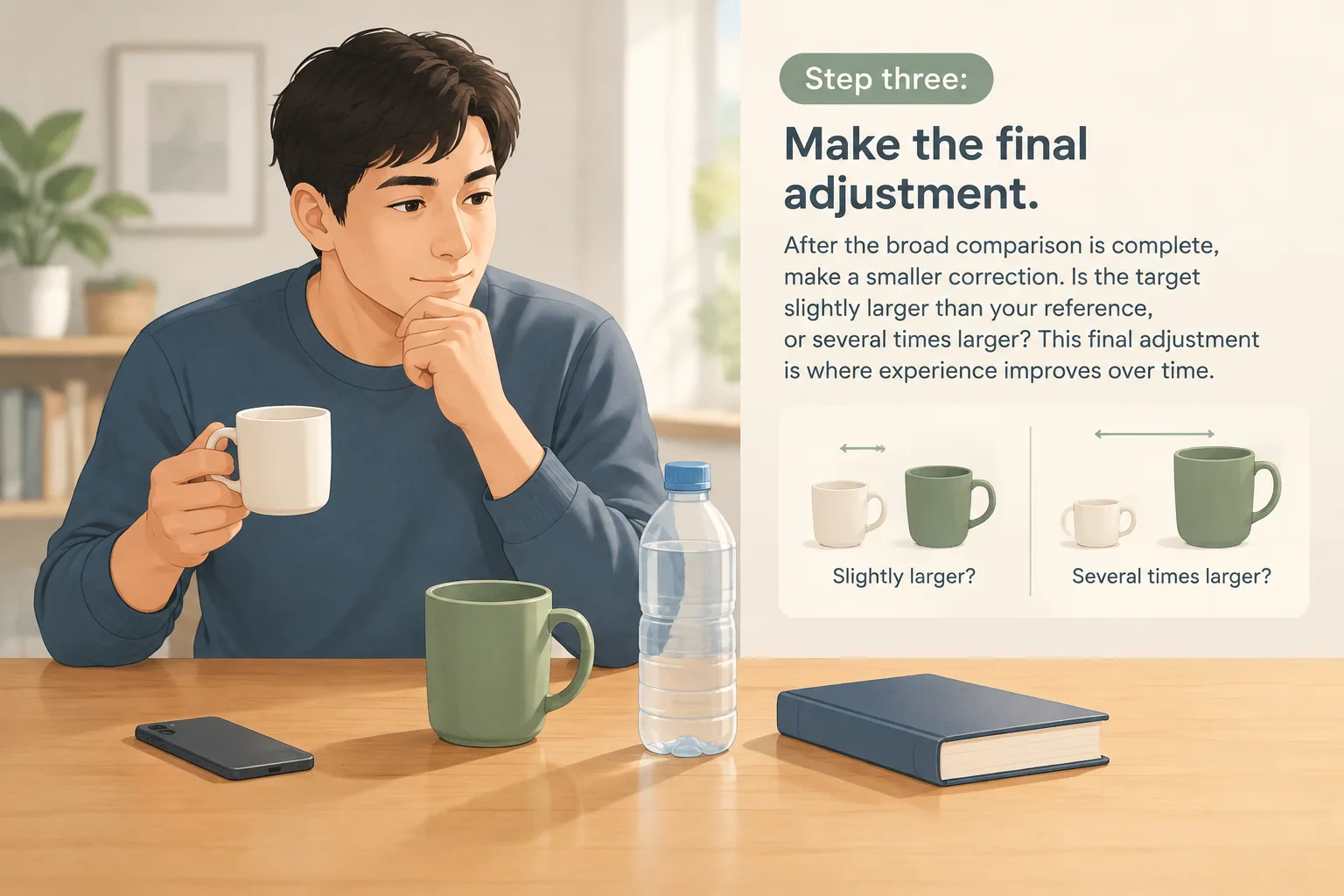
Step three: Make the final adjustment
After the broad comparison is complete, make a smaller correction. Is the target slightly larger than your reference, or several times larger? This final adjustment is where experience improves over time.
How can players improve at size estimation game tips?
Improving at size estimation game tips requires practice with different categories of objects. The goal is not memorizing every possible answer but developing flexible estimation skills.
A useful practice routine includes:
- Comparing objects around your home and estimating their dimensions before checking.
- Looking at landmarks, animals, and vehicles while thinking about relative scale.
- Reviewing previous game comparisons and asking why an estimate was too high or too low.
- Building a mental library of common reference points.
The archive analysis guide can help players review patterns and organize observations from previous games.
Community strategies often recommend checking the largest differences first. If one object appears dramatically larger, determine that relationship before worrying about small adjustments. These approaches are personal techniques rather than official game mechanics.
Why does proportional thinking matter in Size It Up?
Proportional thinking matters because many real-world decisions involve comparing quantities rather than measuring everything directly. Architects, engineers, scientists, and designers often use estimates before detailed calculations.
Size It Up turns this everyday skill into a game format. A player who understands ratios can often make a reasonable judgment even when the exact measurement is unknown.
For example, someone may not know the precise height of a famous structure, but they may understand that it is many times taller than a person. That relationship is often enough to create a useful estimate.
Common mistakes when using size it up tips
Players often struggle because they rely on memory without checking scale. A remembered number may be correct but applied to the wrong comparison.
Another mistake is ignoring the reference object. The reference exists to provide context, so focusing only on the target can lead to inaccurate guesses.
A final mistake is changing an answer repeatedly without new information. Once you have completed a reasonable comparison process, additional hesitation may not improve the result. The official game experience includes locking in an estimate and revealing how close the judgment was.
Frequently Asked Questions
What are the best size it up game tips for beginners?
The best size it up game tips for beginners are to start with familiar reference objects, estimate the broad size category first, and avoid trying to remember exact measurements. Building a sense of proportion is more useful than memorizing isolated facts.
How do I get better at size it up without memorizing answers?
You can learn how to get better at size it up by practicing comparisons in everyday life. Estimate the size of objects around you, compare them with known references, and review mistakes to understand where your scale judgment changed.
Is size it up strategy officially provided by the game creators?
Size it up strategy described in community guides is generally a player-developed approach. The official game explains the comparison and locking process, but personal estimation methods are not official rules or guarantees.
Why are ratios important in size it up game tips?
Ratios are important because the challenge focuses on the relationship between objects. Knowing whether one item is twice, five times, or much larger than another is often more useful than knowing only one object's measurement.
Can size estimation game tips help outside the game?
Yes, size estimation game tips can support general estimation skills used in daily activities. People regularly judge distances, spaces, quantities, and dimensions when planning tasks or making decisions.
Where can I find more Size It Up guides?
You can explore more Size It Up information through the Size It Up Wiki sections covering basics, how to play, variants, and past-game analysis.
Final tips for better Size It Up guesses
The fastest improvement comes from building a repeatable process. Do not treat each comparison as a completely new puzzle. Instead, create a habit: identify the scale, choose a reliable anchor, compare proportions, and make a final adjustment.
Size It Up rewards careful observation and practical reasoning. Whether you are playing daily challenges or exploring different variants, a stronger understanding of scale will make your guesses more consistent.
For continued practice, visit the Size It Up Wiki guides and explore additional strategies, examples, and archives to strengthen your estimation skills.