
size it up reference objects
Size It Up Reference Objects: Real Sizes Worth Memorizing
Learn size it up reference objects with verified real-world measurements from animals, landmarks, vehicles, and structures. Build better scale estimates with practical comparison anchors.

Size It Up Reference Objects: Real Sizes Worth Memorizing
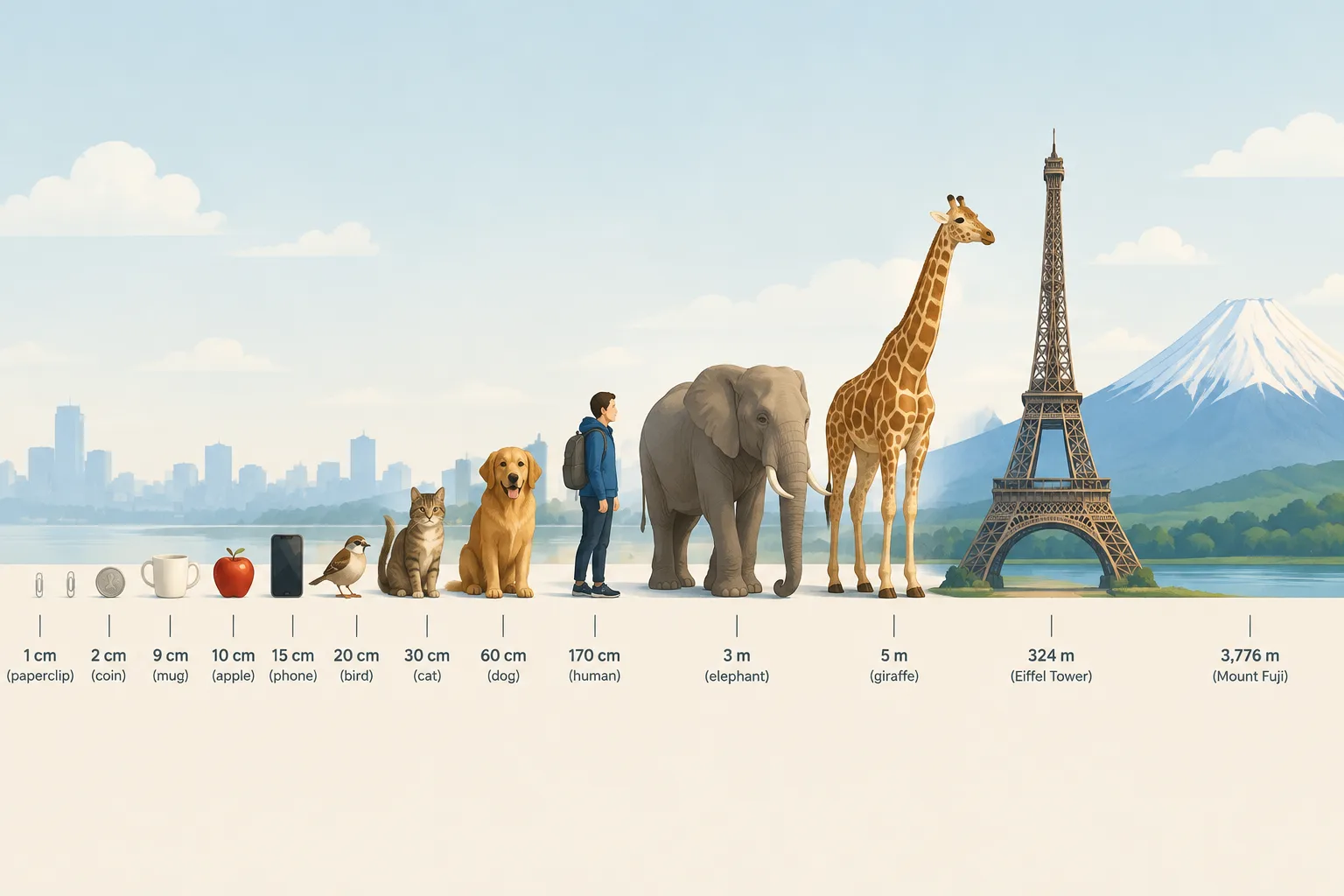
Size It Up reference objects help players turn unfamiliar silhouettes into reasonable guesses by connecting them to things they already understand. The game uses real-world shapes and asks players to estimate size, so remembering a few reliable anchors can make comparisons easier. This guide explains useful size it up object sizes, real world size reference examples, and practical ways to build your own mental measurement library.
For players learning the basics, the main game concept is simple: observe a shape, estimate its size, and adjust your guess as needed. The official Size It Up experience is built around real objects and their measurements, making accurate reference points valuable when practicing. You can also explore the site's guides for basics, how to play, and variants to understand the wider game format.
What are size it up reference objects and why do they matter?
Size it up reference objects are familiar things that help you estimate the dimensions of unknown items. Instead of trying to imagine an exact measurement from a silhouette alone, you compare the object with something you already know. A person, a car, a building floor, or a famous landmark can become a mental ruler.
The most useful references are objects with stable, well-known sizes. A player's memory does not need hundreds of measurements. A small collection of anchors across different scales can cover many situations.
Examples of useful categories include:
- Human-scale objects: people, doors, bicycles, and household items.
- Animal references: whales, elephants, bears, and other recognizable creatures.
- Vehicle references: cars, buses, trains, and aircraft.
- Landmark references: towers, bridges, and large structures.
- Natural references: mountains, trees, and large geological features.
A good reference system works because it creates relationships. Knowing that one object is roughly twice as long as another is often more useful than memorizing an isolated number.
How can you build a real world size reference library?
Building a real world size reference library starts with choosing memorable objects and grouping them by scale. The goal is not to memorize every measurement but to create dependable checkpoints.
Start with everyday measurements:
- A typical adult human height can serve as a basic comparison unit.
- A standard doorway can help estimate smaller structures.
- A common vehicle can help judge medium-sized objects.
Then add larger anchors. For example, the Eiffel Tower is a useful landmark reference because its official height, including antennas, is 330 meters. A blue whale is another powerful comparison point because it can reach about 30 meters in length according to WWF information.
| Reference object | Approximate size or measurement | Why it helps | Source |
|---|---|---|---|
| Blue whale | Up to about 30 meters long | Useful animal-scale anchor | WWF species profile |
| Eiffel Tower | 330 meters including antennas | Useful landmark height anchor | Eiffel Tower official site |
| Polar bear | Large adult males can weigh hundreds of kilograms | Useful animal mass comparison | National Geographic |
These examples show why different categories matter. A whale helps with length, a tower helps with height, and a large animal helps with understanding scale in nature. Players should always check measurements from reliable sources because remembered numbers can become inaccurate over time.
Which animal sizes list entries are useful for estimating scale?
An animal sizes list can provide some of the most memorable reference points because animals vary dramatically in size. Large animals are especially useful because they represent extremes that are difficult to imagine.
The blue whale is one of the strongest large-scale anchors. It is among the largest animals known, with lengths reaching around 30 meters. This makes it a useful mental comparison for very long objects.
Polar bears provide another type of reference. They are among the largest land carnivores, and adult males can reach substantial body mass. They are better used as a weight or bulk comparison than as a length measurement.
When using animals as references, consider the measurement type:
- Length references work well for whales, snakes, and large reptiles.
- Height references work well for giraffes and tall birds.
- Weight references work well for large mammals.
- Body volume references require extra caution because shapes vary significantly.
A common mistake is comparing different measurement types. A tall animal does not automatically represent a heavy object, and a long animal does not always have a large overall volume.
What landmark heights list examples help with large objects?
A landmark heights list helps players understand massive structures because familiar buildings are easier to visualize than abstract numbers. Famous landmarks can serve as mental checkpoints when a silhouette appears extremely large.
Useful landmark anchors include towers, skyscrapers, bridges, and monuments. The Eiffel Tower is a strong example because its height is widely documented. A player who remembers its scale can compare other tall structures against a known reference.
Large landmarks are especially helpful because they provide a bridge between everyday objects and extreme sizes. Most people interact with objects measured in meters, but landmarks introduce hundreds-of-meters and beyond.
When learning landmark references, focus on broad ranges:
- Small structures: a few meters to tens of meters.
- Large buildings: tens to hundreds of meters.
- Major towers and landmarks: hundreds of meters.
Exact memorization is less important than recognizing the difference between categories.
How should players practice size estimation in Size It Up?
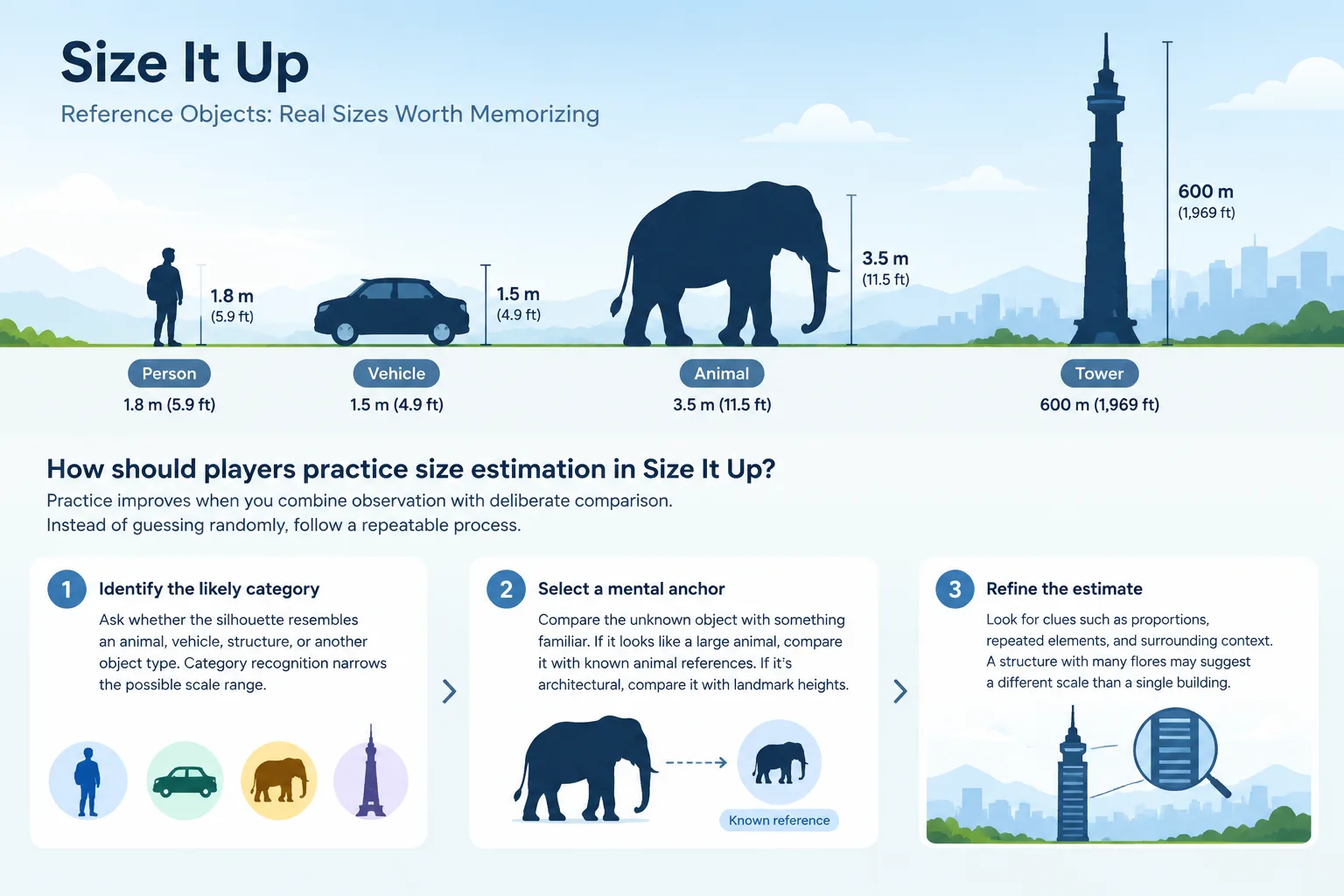
Practice improves when you combine observation with deliberate comparison. Instead of guessing randomly, follow a repeatable process.
First, identify the likely category. Ask whether the silhouette resembles an animal, vehicle, structure, or another object type. Category recognition narrows the possible scale range.
Second, select a mental anchor. Compare the unknown object with something familiar. If it looks like a large animal, compare it with known animal references. If it looks architectural, compare it with landmark heights.
Third, refine the estimate. Look for clues such as proportions, repeated elements, and surrounding context. A structure with many floors may suggest a different scale than a single-story building.
Players can review previous patterns through resources such as the daily answers section and archive analysis tools, while remembering that each puzzle should be evaluated from its own evidence.
What mistakes should you avoid when using size it up object sizes?
The biggest mistake is relying on vague impressions without a reference point. People often underestimate very large objects because human experience is mostly limited to human-scale environments.
Another mistake is treating every measurement as interchangeable. Height, length, width, weight, and volume describe different aspects of size. A useful reference must match the type of comparison you are making.
Players should also avoid memorizing unsupported numbers. A reference object is only helpful when its measurement is reasonably verified. Reliable sources, including official organizations and recognized educational references, are better foundations than repeated guesses from online discussions.
Finally, avoid assuming that a familiar object always has one fixed size. Animals vary by species and individual, vehicles have different models, and structures may have multiple published measurements depending on what is included.
How can you keep improving your reference object knowledge?
Improving your reference knowledge is an ongoing process. Add a few new anchors at a time instead of trying to memorize a massive database.
A practical routine is:
- Choose one small, medium, and large reference object.
- Record the measurement and source.
- Compare new objects against those anchors.
- Update your memory when you discover better references.
Over time, these comparisons create an internal scale map. This helps not only with Size It Up but also with understanding news images, documentaries, architecture, nature, and everyday measurements.
FAQ about size it up reference objects
What are size it up reference objects?
Size it up reference objects are familiar real-world items used as mental comparison points when estimating the size of unknown objects. They help players replace uncertain guesses with more structured comparisons.
Which size it up reference objects are easiest to remember?
The easiest references are usually common objects and famous landmarks. People often remember human height, vehicles, large animals, and recognizable towers because they appear frequently in daily life and media.
How many size it up reference objects should a player memorize?
There is no required number. A small set covering different scales is usually more useful than a long list of isolated measurements. Focus on reliable anchors that you can recall quickly.
Can an animal sizes list improve Size It Up performance?
Yes, an animal sizes list can improve estimation by providing examples of natural scale differences. However, players should match the animal reference to the correct measurement type, such as length, height, or weight.
Why are landmark heights list examples useful?
Landmark heights list examples help players understand very large measurements. Familiar structures create a bridge between everyday objects and enormous scales that are difficult to visualize.
Where can I learn more about playing Size It Up?
Players can learn more through the site's basics guide, how to play guide, and variants overview. These resources explain the game format while this reference guide focuses on real-world size comparisons.
Conclusion: Build your own scale memory
Size it up reference objects are powerful because they transform abstract measurements into familiar comparisons. By learning a balanced collection of animal, landmark, vehicle, and everyday references, players can make more thoughtful estimates and better understand the scale of the world around them.
The best reference library is not the largest one. It is the one built from accurate facts, memorable examples, and regular practice. Start with a few dependable anchors, expand gradually, and use each new puzzle as an opportunity to improve your sense of scale.